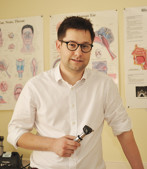
 Dr Henry Dunne, Cambridge University Hospital Trust
HEAD position sensing for the particle repositioning manoeuvre technique in benign paroxysmal positional vertigo: A validation and feasibility study (HEADSPIN)
Dr Dunne’s research seeks to develop and test a new medical device and app which are designed to support clinicians to treat a condition called Benign Paroxysmal Positional Vertigo (BPPV).
BPPV is the most common cause of vertigo. It is caused by debris floating within the inner ear. Movement of the debris as the head moves (e.g. turning over in bed) leads to sensation of spinning; this can increase risk of falls, limit activity, induce anxiety, and lead to hospitalisation.
The treatment for BPPV is a manoeuvre called the particle repositioning manoeuvre (PRM), whereby a clinician moves a patient through a series of positions with the aim of freeing the debris from the inner ear. Correctly performing the manoeuvre has a very high cure rate.
Currently the manoeuvre tends only to be performed by experienced ENT and vestibular specialists. By providing a device that supports other clinicians to perform this treatment, they hope to expand access to the treatment.
Their device is designed as a headband that monitors the position of a patient’s head-in-space which is displayed to a clinician on a screen. Thanks to previous research, from this information they predict the orientation of the inner ear balance organs. As the patient is moved through the positions of the PRM, the clinicians can use the display to ensure they are correctly positioning the patient and dislodging any debris.
After optimising their device and app, they will test them in a group of patients who have BPPV and gain feedback on their usability from key clinical stakeholders.

Dr Michael Mather, Newcastle University
Spatial transcriptomic mapping of human endolymphatic sac
Meniere’s disease causes hearing loss, tinnitus, and dizziness. It is thought to be due to excessive fluid in a part of the ear called the endolymphatic sac (ELS). Historically, this has been challenging to research due to the closed anatomical location of the ELS deep in the inner ear. This has made developing new treatments difficult.
In large centres, such as ours, patients are referred with benign tumours on the nerves of hearing and balance. For some, these are best removed using an approach which goes through the ear and would usually result in destruction of the ELS. They propose to sample the ELS from patients undergoing this procedure. They will then use advanced technologies in the lab to generate a readout of which genes are active in each individual cell in the sample, whilst also preserving the structural information about the ELS.
This will provide a world-first tissue atlas of normal human endolymphatic sac, which will be a pivotal resource to help understand the cells present and the genes which control their function. This will provide researchers with a reference to understand the normal anatomy and function of the ELS to later understand what goes wrong in Meniere’s disease.

Mr Matthew Smith, University of Exeter
VR2: Vestibular rehabilitation based in virtual reality
Mr Smith’s past research showed that people with Meniere's disease, an inner ear disorder, have different balance abilities compared to healthy individuals, especially when standing on a vibrating surface.
Now, his research will explore how specific environments and situations affect people with Meniere's. Hie team will use 360-degree videos and motion data to create immersive experiences. First, they will talk to people with Meniere's to understand which environments and scenarios they find particularly challenging due to their symptoms.
Then, using virtual reality (VR) headsets and a moving platform, they will recreate these difficult environments. Standing on a moving train, navigating a bustling supermarket, or crossing a wobbly bridge - they will bring these experiences to our participants, including the sights, sounds, and movements.
By immersing participants in these virtual environments and measuring changes in their balance control, visual focus, and Meniere's symptoms, they aim to understand what specific stimuli make these environments so difficult to navigate. They also hope to identify any coping mechanisms that could help improve their balance control in real-world situations.


 Dr Lukas Mach, Imperial College London
  Dr Christopher Bannon, Institute of Metabolic Science, University of Cambridge
 Mr Vid Mlakar and Dr Elise Halff, Kings College London
 Professor Simon Walker-Samuel, Centre for Computational Medicine, University College London and Dr Emmeline Brown, University College London
  Mr Bharadhwaj Ravindhran, Hull Royal Infirmary
  Dr Rebecca Preston, University of Manchester
  Dr Eleanor Quek, Imperial College London
  Dr Yin Zhou, Queen Mary University of London
 Dr Hassan Awan, Keele University and Dr Mohammed Mustafa, Cardiff University


